On this page
- How do you get screened for skin cancer?
- What are the warning signs of skin cancer?
- Which Wichita providers focus on skin cancer checks?
- How much does skin cancer screening cost in Wichita?
- What happens if a spot needs treatment?
- How quickly should skin cancer be treated?
- How can you lower your skin cancer risk between checks?
- FAQs
Most skin checks start with a spot someone else noticed first. A spouse, a hairdresser, a photo from last summer. Then comes the question of how fast you can get in.
Skin cancer screening is a head-to-toe skin exam by a dermatologist to find cancer early, when it's easiest to treat. If you're looking for skin cancer screening in Wichita, this page covers what the exam involves, what it costs, and what happens if something looks off.
Below, you'll find the warning signs to watch for, which Wichita providers focus on skin checks, published local fees, and how melanoma and basal cell carcinoma are treated here.
How do you get screened for skin cancer?
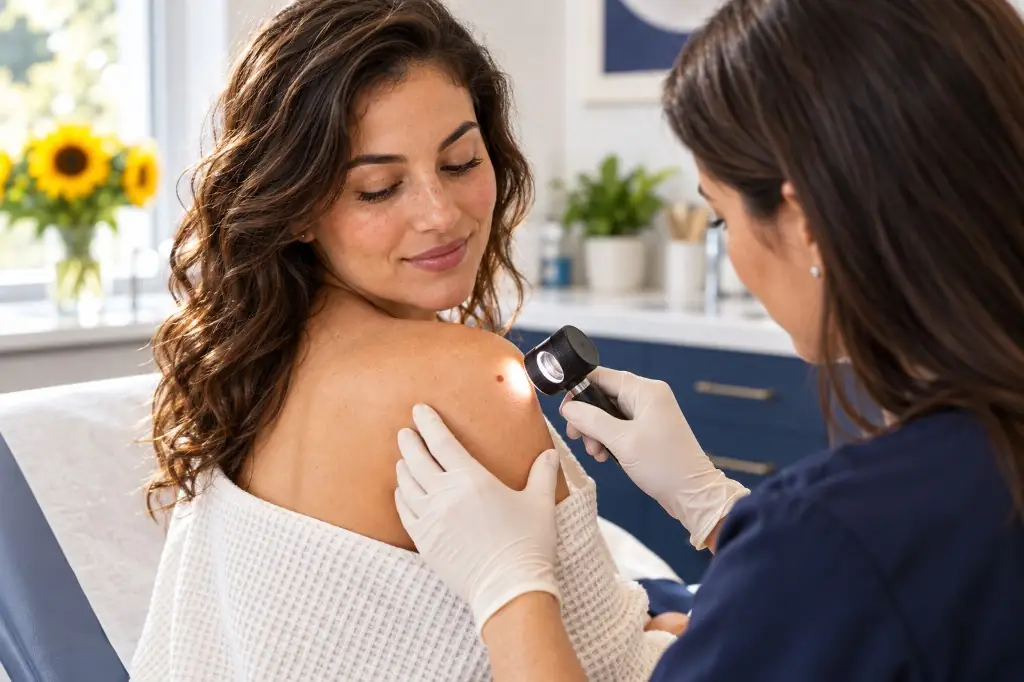
You book a full-body skin exam with a dermatologist. You change into a gown, and the dermatologist checks your skin from scalp to soles, often with a handheld magnifier called a dermatoscope. Any suspicious spot is biopsied and sent to a lab.
Here's what a thorough skin check includes:
- History. Past skin cancers, family history, sunburns, tanning, and any spot you're worried about.
- Head-to-toe exam. Scalp, face, ears, trunk, arms, legs, between toes, soles and nails.
- Dermoscopy. A close look at pigmented spots through a dermatoscope.
- Biopsy (if needed). A small sample is removed and sent to pathology.
- A plan. When to come back, and what to watch for between visits.
How do I make sure a spot isn't missed?
Point it out. Take photos of anything new or changing, and show them at the start of the visit.
That advice comes from a real scenario. One patient wrote: "The derm couldn't even see this spot until I showed her a photo, so it scares me to know it would've been overlooked during a general skin check." Another commenter described insisting that a changing mole be removed after the dermatologist was doubtful. It turned out to be melanoma.
You're allowed to ask for a biopsy or a second opinion. Use it.
Pro Tip: Before your appointment, photograph any spot you're worried about next to a coin for scale. Date the photo. Change over time is what a dermatologist needs to see.
Who should get skin cancer screening?
The US Preventive Services Task Force found "inadequate evidence" that routine clinician skin checks help people at average risk with no symptoms. Screening matters most if you have a new or changing spot, a past skin cancer, lots of moles, fair skin, or a family history. Source pending
What are the warning signs of skin cancer?
Watch for a spot that's new, changing, or different from your other moles. Dermatologists use the ABCDE rule: Asymmetry, uneven Borders, several Colors, a Diameter larger than a pencil eraser, and Evolving size, shape or color. Sores that don't heal also count.
Here are 7 warning signs to know:
- Asymmetry: one half doesn't match the other.
- Border: ragged, blurred or notched edges.
- Color: more than one shade, or black, red, white or blue areas.
- Diameter: larger than a pencil eraser (though melanomas can be smaller).
- Evolving: any change in size, shape, color or height.
- A sore that won't heal, or heals and comes back.
- A spot that bleeds, itches or crusts without an injury.
What does skin cancer on the face look like?
Basal cell carcinoma often looks like a pearly or shiny bump, a pink patch, or a sore that bleeds and scabs over and over. Squamous cell carcinoma often looks like a rough, scaly red patch or a firm bump. Melanoma usually looks like a dark, uneven, changing mole.
Skin cancer on darker skin often shows up in less-sunny places, like the palms, soles and under the nails. For dermatologists experienced with darker skin, see our skin of color dermatology guide.
Which Wichita providers focus on skin cancer checks?
All five of Wichita's top dermatology practices treat skin cancer. At Wichita Dermatology & Aesthetics, several providers list skin-cancer screening as a focus. Wichita Skin & Mohs and Heartland Dermatology also offer Mohs surgery for confirmed cancers.
| Provider | Credential | Practice | Listed focus |
|---|---|---|---|
| Landon M. Johnson | MD, FAAD | Wichita Dermatology & Aesthetics | Skin cancer; Mohs / micrographic surgery (board-certified in both) |
| Karen Bohaty | PA-C | Wichita Dermatology & Aesthetics | Skin checks |
| Bridgette Hull | DNP, APRN, FNP-C | Wichita Dermatology & Aesthetics | Skin-cancer screening |
| Sarah Johnson | APRN-BC | Wichita Dermatology & Aesthetics | Skin-cancer prevention and surveillance |
| Schuyler Stump | MPAS, PA-C | Wichita Dermatology & Aesthetics | Skin-cancer screening; bio states new and established patients |
| Jace Rickstrew | MD | Heartland Dermatology | Mohs surgery (bio claim, not yet board-verified) |
From each practice's provider page, checked September 2026. Other practices' skin-check providers: Not yet verified. Not a ranking.
Two local reviews give a sense of what patients value. One said "the skin cancer screening exam was thorough." Another wrote: "I am so grateful she noticed my melanoma and continues to care for my skin."
How much does skin cancer screening cost in Wichita?
A skin check is billed as an office visit. Heartland Dermatology, the one top Wichita practice that publishes prices, lists new-patient visits at $122.47 to $289.56 as standard fees. A biopsy adds $153.32 to $194.25, plus $59.34 for the lab reading.
| Service | CPT code | Heartland standard fee |
|---|---|---|
| New patient visit (levels 2 to 4) | 99202 to 99204 | $122.47 to $289.56 |
| Shave biopsy | 11102 | $153.32 |
| Punch biopsy | 11104 | $194.25 |
| Pathology (lab reading) | 88305 | $59.34 |
| Freezing a pre-cancer (first spot) | 17000 | $107.07 |
| Freezing pre-cancers (spots 2 to 14, each) | 17003 | $10.27 |
| Malignant excision, trunk/arms/legs, 0.5 cm or less | 11600 | $317.89 |
| Mohs surgery, first stage (head, neck, hands, feet) | 17311 | $1,075.38 |
Source: heartland-derm.com/price-transparency, checked September 29, 2026. Standard fees, not patient out-of-pocket costs.
Insurance coverage for a screening with no symptoms varies by plan. A check for a specific spot you're worried about is usually billed as a medical visit. Not yet verified
The full breakdown, including how to avoid surprise add-on bills, is in our dermatologist cost guide.
How much does it cost to get a melanoma removed?
At Heartland's published standard fees, a small skin cancer excision on the trunk, arms or legs is $317.89, and a first stage of Mohs on the face, hands or feet is $1,075.38. Larger melanomas and any lymph node testing cost more. Not yet verified
What happens if a spot needs treatment?
If the biopsy shows cancer, your dermatologist recommends treatment based on the type, size and location. Most basal and squamous cell cancers are cut out or removed with Mohs surgery. Melanoma is usually treated with a wider excision. Pre-cancers are often frozen.
| Type | What it is | Usual first treatment |
|---|---|---|
| Actinic keratosis (pre-cancer) | Rough, scaly sun-damage spots | Freezing, prescription creams |
| Basal cell carcinoma (BCC) | The most common skin cancer; slow-growing | Excision, Mohs, or scraping and burning for small ones |
| Squamous cell carcinoma (SCC) | More likely than BCC to grow deeper | Excision or Mohs |
| Melanoma | The most dangerous common skin cancer | Wide local excision; more tests depending on depth |
Wichita Dermatology & Aesthetics notes on its skin cancer page that, because of the nature of melanoma, it's usually treated with wide local excision.
For cancers on the face, hands or feet, see our guide to Mohs surgery in Wichita.
How do results get delivered?
Ask before the biopsy. One patient got their squamous cell carcinoma result by message "at 5pm on a Friday," next to their eye, right as the office closed. Ask whether results come by phone, portal or visit, and who to call after hours.
How quickly should skin cancer be treated?
Melanoma should be treated promptly because it can spread. Basal cell carcinoma grows slowly and rarely spreads, but it keeps damaging nearby skin. Book treatment soon after diagnosis, and ask for a cancellation list if the wait is long.
What should I do if a spot changes before my next check?
Call the office, say the spot is changing, and ask for the earliest opening or a cancellation-list spot. Bring photos. One patient with a past squamous cell cancer on six-month checks spotted a new raised mole and was told the next opening was weeks away. Changing spots are worth a phone call, not a wait.
How long does melanoma take to go from stage 1 to stage 4?
No set timeline exists. Melanoma grows at different speeds in different people. That's exactly why a changing mole should be checked promptly. Source pending
What is the 2 week rule for melanoma?
The 2 week rule is a UK National Health Service target for seeing a specialist after an urgent cancer referral. It doesn't apply in the US. In Wichita, tell the office a spot is changing and ask for the earliest slot.
How can you lower your skin cancer risk between checks?
Protect your skin from sun, skip tanning beds, and check your own skin monthly. Use broad-spectrum sunscreen, wear hats and long sleeves outdoors, and look for new or changing spots. The American Academy of Dermatology offers a free body mole map to track spots.
Now that you know the signs, the monthly self-check is simple:
- Check your whole body in a full-length mirror, plus a hand mirror for your back.
- Look at your scalp, between your toes and your soles.
- Compare with last month's photos.
- Book a skin check for anything new, changing, itching or bleeding.
Not sure what else a dermatologist handles? See what a dermatologist does. And for moles you just want removed, see mole, wart and skin tag removal.
Ready for a skin check? Request an appointment and we'll help you find a Wichita dermatologist who can see you.
Skin Cancer Screening FAQs
How much does skin cancer screening cost in Wichita?
Heartland Dermatology lists new-patient visits at $122.47 to $289.56 as standard fees. Biopsies add $153.32 to $194.25 plus $59.34 for the lab. Insurance changes what you pay.
Is basal cell carcinoma very serious?
BCC rarely spreads, but it keeps growing into nearby skin if left alone. On the face, that means a bigger surgery later. Treat it once diagnosed.
Is melanoma one of the worst skin cancers to have?
Melanoma is the most dangerous common skin cancer because it can spread. Caught early, it's usually treated with surgery alone. That's why changing moles need a prompt check.
How to stop skin cancer from spreading?
Get new or changing spots checked early and treat confirmed cancers promptly. Early removal is the most effective step.
How often should I get a skin check?
Your risk sets the schedule. People with a past skin cancer or several risk factors are often checked every 6 to 12 months. Ask your dermatologist what's right for you.
Can I ask for a mole to be biopsied?
Yes. If a spot worries you, say so and ask for a biopsy or a second opinion. Bring photos showing how it changed.
What does a skin cancer screening involve?
A head-to-toe skin exam in a gown, a close look at spots with a dermatoscope, and a biopsy of anything suspicious. The exam itself usually takes a short visit.
Do I need a referral for a skin cancer screening?
Your insurance plan decides. Check your plan or call the number on your card before booking.